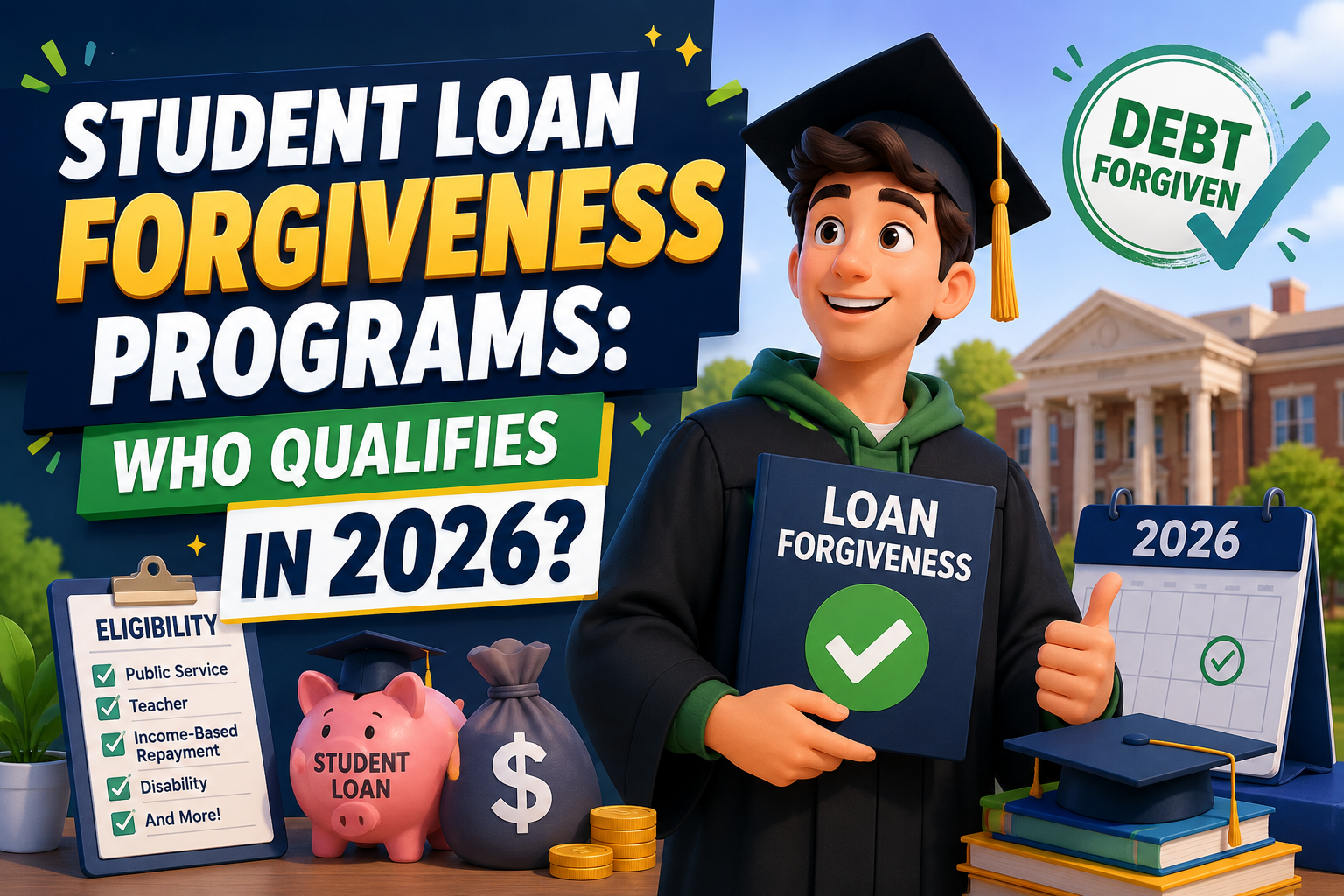
Understanding Student Loan Forgiveness in 2026
Federal student loan forgiveness is not one universal program that automatically eliminates every borrower’s balance. Instead, several separate programs offer forgiveness, cancellation or discharge when borrowers meet specific employment, repayment, disability or school-related requirements.The correct option depends on the type of federal loan you have, your employer, payment history and personal circumstances. Private student loans generally do not qualify for federal forgiveness programs.
Major 2026 update: The SAVE repayment plan ended following a court order on March 10, 2026. The new income-driven Repayment Assistance Plan became available on July 1, 2026. Borrowers affected by the SAVE closure should review their official notice and select another eligible repayment plan rather than assuming their account will automatically remain on the same terms.
Quick Eligibility Snapshot
Public-Service Workers
May qualify through PSLF after 120 qualifying monthly payments while working full time for an eligible employer.
Teachers
May receive up to $17,500 after five complete and consecutive years at an eligible school or educational agency.
Long-Term IDR Borrowers
A remaining balance may be forgiven after completing the required repayment period under an eligible income-driven plan.
Misled Students
Borrower defense may help Direct Loan borrowers whose school made qualifying misrepresentations or committed certain misconduct.
Students of Closed Schools
A discharge may be available when a school closes while the borrower is enrolled or shortly after withdrawal.
Permanently Disabled Borrowers
Federal loans may be discharged when a qualifying physical or mental disability severely limits the borrower’s ability to work.
01
Public Service
Public Service Loan Forgiveness
Public Service Loan Forgiveness, commonly called PSLF, can forgive the entire remaining balance of eligible Direct Loans after a borrower makes 120 qualifying monthly payments while working full time for an eligible government or nonprofit employer. Eligibility is determined primarily by the organization employing you, not by your job title. A nurse, administrator, maintenance worker, accountant or technology specialist may qualify when employed by an eligible organization. Borrowers generally need Direct Loans and must make payments under a qualifying repayment plan. People with older FFEL or Perkins Loans may need to consolidate those loans into a Direct Consolidation Loan, although consolidation can affect previous payment credit and access to Perkins cancellation. The definition of a qualifying PSLF employer was updated effective July 1, 2026. Borrowers should use the official Employer Search and submit a PSLF form regularly to confirm their employer and payment count.
02
Education
Teacher Loan Forgiveness
Teachers may qualify for forgiveness after working full time for five complete and consecutive academic years at an eligible low-income elementary school, secondary school or educational service agency. Highly qualified special-education teachers and qualifying secondary mathematics or science teachers may receive up to $17,500. Other qualifying teachers may receive up to $5,000. The program generally applies to eligible Direct Subsidized and Unsubsidized Loans and certain Federal Stafford Loans. PLUS Loans and Perkins Loans are not forgiven through Teacher Loan Forgiveness. A borrower cannot use the same period of teaching service to receive both Teacher Loan Forgiveness and PSLF credit. Teachers should compare the potential value of both programs before submitting a forgiveness application. A teacher with a large loan balance may benefit more from continuing toward PSLF.
03
Income-Based Repayment
Income-Driven Repayment Forgiveness
Income-driven repayment plans calculate monthly payments using income, family size and the rules of the selected plan. Under older plans such as IBR, PAYE and ICR, eligible remaining balances may be forgiven after 20 or 25 years of qualifying repayment, depending on the plan and the borrower’s loan history. The new Repayment Assistance Plan is available to eligible Direct Loan borrowers from July 1, 2026. RAP payments are based on a percentage of adjusted gross income, reduced by $50 for each qualifying dependent, with a minimum monthly payment of $10. Any remaining balance may be forgiven after 30 years, or 360 qualifying monthly payments. Borrowers taking out a new loan or consolidating loans on or after July 1, 2026, generally have RAP and the Tiered Standard Plan as their principal repayment choices. Because repayment rules are transitioning, borrowers should use the official repayment calculator instead of relying on an old estimate.
04
School Misconduct
Borrower Defense to Repayment
Borrower defense may discharge eligible federal loans when a school misled a borrower or engaged in misconduct that violated applicable law and directly influenced the decision to enroll or continue attending. Simply being dissatisfied with a program, failing to find employment or believing tuition was too expensive is not automatically enough. Applicants should submit clear evidence, such as enrollment agreements, advertisements, emails, program promises, employment statistics or communications from school representatives. Borrower defense primarily applies to Direct Loans. Certain FFEL or Perkins Loans may become eligible after consolidation into the Direct Loan Program. However, borrowers should understand the consequences of consolidation before proceeding.
05
School Closure
Closed School Discharge
A borrower may qualify when the school closes while the borrower is enrolled and the closure prevents completion of the educational program. Eligibility may also apply when the school closes within 180 days after the borrower withdraws. A discharge generally is not available when the student withdrew more than 180 days before closure, completed all required coursework or is completing a comparable program through a transfer or teach-out arrangement. Borrowers should collect enrollment records, withdrawal information, school communications and evidence showing how the closure prevented program completion.
06
Disability
Total and Permanent Disability Discharge
TPD discharge may eliminate federal student loans and a TEACH Grant service obligation when a physical or mental disability severely limits the borrower’s ability to perform substantial gainful activity now and in the future. Eligibility can be demonstrated through qualifying documentation from the Department of Veterans Affairs, the Social Security Administration or an authorized medical professional. Some borrowers identified through government records may receive automatic-discharge notification, while others must apply and submit supporting evidence. Receiving SSDI or SSI does not by itself guarantee approval. The Social Security disability record must meet specific review-period, onset-date or compassionate-allowance conditions.
07
Older Federal Loans
Perkins Loan Cancellation
Borrowers who still have Federal Perkins Loans may qualify for partial or complete cancellation through certain public-service occupations. Eligible teachers can receive up to 100% cancellation over five years of qualifying service. Teacher cancellation is generally applied gradually: 15% for each of the first two years, 20% for the third and fourth years and 30% for the fifth year. Qualifying service can include teaching at a low-income school or teaching specified shortage subjects. Applications are handled by the school that issued the Perkins Loan or the organization servicing it. Consolidating a Perkins Loan may remove access to Perkins-specific cancellation, so borrowers should compare options first.How to Check and Apply
- Sign in to your StudentAid.gov account and identify every federal loan type.
- Review your repayment history and confirm which payments have been credited.
- Match your circumstances with the correct forgiveness or discharge program.
- Collect employment, school, medical or income documents before applying.
- Submit forms through official government channels and save confirmation records.
- Continue required payments unless your servicer confirms that an approved pause applies.
- Check the application status and respond quickly to requests for additional evidence.
Mistakes That Can Delay Forgiveness
- Assuming every federal loan qualifies without checking the loan type.
- Remaining on an ended or ineligible repayment plan.
- Failing to certify PSLF employment regularly.
- Consolidating Perkins Loans without reviewing lost cancellation benefits.
- Using the same teaching-service period for TLF and PSLF.
- Submitting a borrower-defense claim without supporting evidence.
- Paying a private company for an application that is available free through official channels.
Frequently Asked Questions
Are private student loans eligible?
No. Federal forgiveness and discharge programs generally apply only to qualifying federal student loans. Private lenders may offer hardship programs, but they are not part of federal forgiveness.Is the SAVE plan still available in 2026?
No. The plan ended after a court order on March 10, 2026. Affected borrowers are being directed to review and select another eligible repayment plan.Is forgiveness automatic after the required period?
Not always. Some programs require an application, employment certification or supporting evidence. Borrowers should monitor official payment counts and notices.Will forgiven debt be taxed?
Tax treatment depends on the forgiveness program and applicable federal and state law. PSLF forgiveness is generally not treated as federal taxable income, while some long-term repayment forgiveness may have different tax consequences.Final Thoughts
Student loan forgiveness remains available in 2026, but approval depends on meeting the exact requirements of a specific program. Public-service employees, teachers, long-term income-driven borrowers, permanently disabled borrowers and students affected by school misconduct or closure may each have a different path. Start by identifying your loan type and checking current information through your StudentAid.gov account. Do not rely on social-media promises or companies claiming guaranteed approval. Correct paperwork, accurate payment records and regular account monitoring are usually more valuable than any paid forgiveness service.
Disclaimer: This article provides general educational information and does not guarantee student loan forgiveness. Federal regulations, repayment plans, court decisions and tax rules may change. Confirm your eligibility through Federal Student Aid, your official loan servicer or an appropriate financial or tax professional.