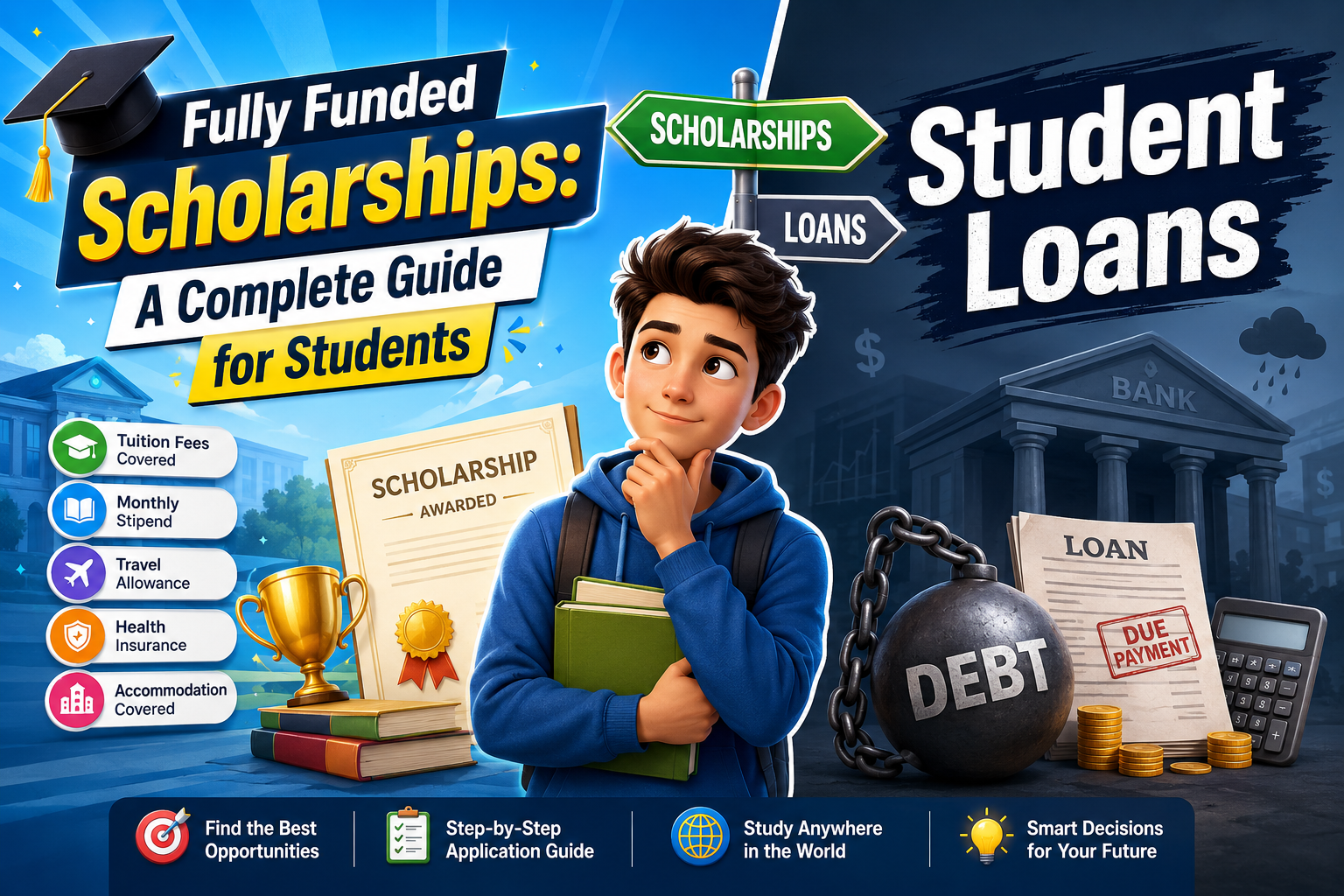
Studying at a respected university can be expensive when tuition, accommodation, travel, insurance and daily costs are combined. Fully funded scholarships can remove much of this pressure by covering several major expenses instead of offering only a small tuition discount.
These awards are competitive, but they are not reserved only for students with perfect grades. Committees may also evaluate leadership, service, research potential, career goals and future impact.
These awards are competitive, but they are not reserved only for students with perfect grades. Committees may also evaluate leadership, service, research potential, career goals and future impact.
What “Fully Funded” Really Means
Fully funded does not always mean every personal expense will be paid. Coverage depends on the provider and award letter. A package may include full tuition, a living allowance, travel, health insurance, visa support, books or research funding.
Read the terms carefully. Check whether the stipend is realistic, whether family expenses are included and whether the scholarship has a tuition cap.
Read the terms carefully. Check whether the stipend is realistic, whether family expenses are included and whether the scholarship has a tuition cap.
Tuition Coverage
The scholarship may pay the complete university tuition fee or a specified maximum amount.
The scholarship may pay the complete university tuition fee or a specified maximum amount.
Living Allowance
Students may receive a monthly stipend for accommodation, food and basic personal expenses.
Students may receive a monthly stipend for accommodation, food and basic personal expenses.
Travel Support
Some awards cover international flights, local transportation or relocation expenses.
Some awards cover international flights, local transportation or relocation expenses.
Additional Benefits
Insurance, visa fees, books, research costs and conference funding may also be included.
Insurance, visa fees, books, research costs and conference funding may also be included.
Four Main Types of Funding
University-funded awards are often offered directly by institutions. Government scholarships are supported by national agencies to attract international talent or develop future leaders. International programmes fund study across participating countries or universities. Foundation and research awards support applicants in particular academic or social-impact areas.
Popular Fully Funded Opportunities
Chevening Scholarships
Chevening supports selected students completing a one-year master’s degree in the United Kingdom. Its official website describes Chevening scholarships as fully funded and emphasizes leadership, professional experience and future impact.Erasmus Mundus
Erasmus Mundus Joint Masters are delivered by groups of universities. Students apply directly to a particular programme. Official Erasmus information states that scholarship holders are not charged tuition or mandatory participation costs, while current programme information lists individual support of €1,400 per month for up to 24 months.Fulbright Foreign Student Program
The Fulbright Foreign Student Program enables graduate students, professionals and artists to study or conduct research in the United States. Benefits differ by country, so use the official country page.DAAD Scholarships
DAAD maintains an official database containing scholarship programmes for international students, graduates, doctoral candidates and researchers interested in Germany. Funding and eligibility vary by programme.Commonwealth Scholarships
Commonwealth Master’s Scholarships support eligible candidates from specified low- and middle-income Commonwealth countries. The official commission does not charge an application fee, but nomination routes and eligibility rules must be checked for each cycle.Seven-Step Scholarship Roadmap
1
Define Your Academic Direction
Begin with the degree, subject and career outcome you want. Applying for unrelated programmes only because they provide funding usually creates weak essays. Reviewers want to see a logical connection between your previous education, proposed course and future contribution.
Write a short career plan explaining what problem you want to solve, which knowledge you lack and how the chosen programme fills that gap.
Write a short career plan explaining what problem you want to solve, which knowledge you lack and how the chosen programme fills that gap.
2
Build a Scholarship Shortlist
Create a spreadsheet containing the scholarship name, country, level, subjects, deadline, language requirement, tests and recommendation process. Separate opportunities into ambitious, realistic and safer options.
Verify every opportunity through the official provider. Social posts and blogs can help discovery, but they should not be treated as the final authority for deadlines or coverage.
Verify every opportunity through the official provider. Social posts and blogs can help discovery, but they should not be treated as the final authority for deadlines or coverage.
3
Check Eligibility Line by Line
Eligibility may depend on nationality, residence, degree results, work experience, age, admission status or a commitment to return home. A strong profile cannot overcome a mandatory rule.
Mark each requirement as completed, pending or not eligible. Do not spend weeks preparing an application when a basic condition is missing.
Mark each requirement as completed, pending or not eligible. Do not spend weeks preparing an application when a basic condition is missing.
4
Prepare a Strong Document Set
Common requirements include transcripts, degree certificates, passport identification, a CV, recommendation letters, proof of language ability, research proposals and admission documents.
Use a clean CV focused on achievements. Replace general claims with evidence, such as leading a team, improving a process, publishing research or organizing a community project.
Use a clean CV focused on achievements. Replace general claims with evidence, such as leading a team, improving a process, publishing research or organizing a community project.
5
Write a Purpose-Driven Essay
A scholarship essay should not repeat the CV. It should explain why the programme matters, what experiences shaped your goals and how the funding will create wider value.
Use specific examples. Instead of saying you are a leader, describe a difficult situation, the action you took and the result. Connect your story to the scholarship’s mission without copying its website.
Use specific examples. Instead of saying you are a leader, describe a difficult situation, the action you took and the result. Connect your story to the scholarship’s mission without copying its website.
6
Choose Recommenders Carefully
A powerful recommendation comes from someone who knows your work and can provide examples. A detailed letter from a lecturer or supervisor is usually more useful than a generic letter from a famous person.
Contact recommenders early. Provide your CV, programme details, deadline and a summary of projects they supervised. Never submit a letter you wrote dishonestly on someone else’s behalf.
Contact recommenders early. Provide your CV, programme details, deadline and a summary of projects they supervised. Never submit a letter you wrote dishonestly on someone else’s behalf.
7
Prepare for Interviews
Shortlisted applicants may be asked about leadership, academic choices, current affairs, career plans and expected impact. Review your application because interviewers may question any statement in it.
Practice concise answers without memorizing a script. Prepare examples showing teamwork, failure and problem-solving.
Practice concise answers without memorizing a script. Prepare examples showing teamwork, failure and problem-solving.
Scholarship Versus Student Loan
Scholarship
A scholarship is normally an award that does not need to be repaid. It may be based on academic merit, financial need, leadership, talent or membership in a particular group.Student Loan
A student loan is borrowed money that usually must be repaid with interest. Federal Student Aid advises students to compare the complete package, which may include grants, scholarships, work-study and loans.
Smart funding rule: Use scholarships and grants first. Borrow only what is needed after comparing costs and repayment terms.
Mistakes That Reduce Your Chances
- Sending the same personal essay to every scholarship.
- Ignoring nationality, experience or academic eligibility rules.
- Submitting recommendation letters with no specific examples.
- Waiting until the final day to upload documents.
- Hiding academic gaps or inventing achievements.
- Trusting anyone who guarantees scholarship selection.
Selection teams may request evidence and reject inaccurate applications. Be cautious of scams. Legititimate providers do not guarantee selection. Commonwealth’s official commission states that it does not charge applicants to use its application system.
Frequently Asked Questions
Do I need perfect grades?
Not always. Academic performance matters, but leadership, research, work experience and impact can also influence selection.
Can undergraduates receive full funding?
Yes, although many famous international programmes focus on postgraduate study. Universities and governments also offer undergraduate awards.
Can I apply before receiving admission?
It depends on the programme. Some scholarship and university applications are combined, while others require a separate offer.
Should I apply for several scholarships?
Yes. A balanced shortlist improves your chances, provided every application is customized.
Final Guidance
Fully funded scholarships can make international education possible without creating a large student-loan burden. Success begins with choosing the right programme, verifying official eligibility and showing a clear connection between your past work and future goals.Start early, build reusable documents and improve every essay through careful editing. A scholarship application should show more than financial need. It should convince reviewers that investing in your education will create lasting value for your field or community.
Disclaimer: Scholarship availability, deadlines, funding amounts and eligibility requirements may change. Students should confirm all details through the scholarship provider’s official website before applying.