Paying for education can be one of the biggest financial decisions a student and family makes. Tuition is only one part of the picture. Books, transportation, accommodation, technology, meals, supplies, and other everyday expenses can significantly increase the total cost of attending school, college, or university.
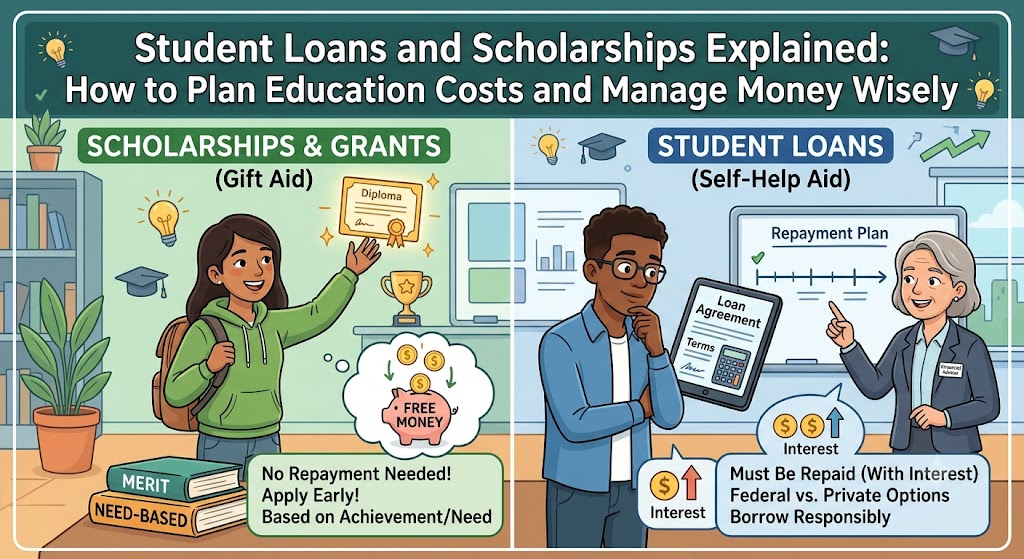
Scholarships and student loans are two common ways students may receive financial support, but they work very differently. A scholarship generally provides funding that does not need to be repaid when the student meets its conditions, while a loan involves borrowing money that normally must be repaid under agreed terms.
Understanding the difference between these options can help students make more informed decisions. A good education-financing plan starts by calculating the actual cost of study, identifying available assistance, and borrowing only when necessary.
Understand the Real Cost of Education
Students sometimes focus only on tuition when estimating their education budget. This can lead to an unrealistic financial plan because several additional expenses may appear throughout the academic year.
Course and institutional fees.
Housing, food, and utilities.
Books, supplies, and software.
Transportation and commuting.
Make a complete list of expected costs before deciding how much financial assistance may be needed. Separating essential education expenses from optional spending can also make the final budget easier to manage.
Scholarships: What Students Should Know
Scholarships can reduce the amount students need to pay from their own resources or borrow. Depending on the program, scholarships may be awarded based on academic performance, financial need, athletic or artistic ability, community involvement, leadership, field of study, or other criteria.
Some scholarships are offered by educational institutions, while others come from governments, nonprofit organizations, professional associations, foundations, or private organizations.
Common scholarship requirements
- Proof of enrollment or admission
- Academic records
- Personal or financial information
- Recommendation letters in some cases
- Personal statements or essays
- Specific eligibility criteria
- Submission before the stated deadline
Do Not Wait Until the Last Minute
Scholarship applications often have specific deadlines. Students can improve their organization by creating a simple calendar containing application dates, required documents, contact information, and submission status.
Preparing common documents in advance can also make the process easier. Keep academic records, proof of enrollment, identification documents, and other frequently requested information organized in a secure location.
A simple tracking system
Program → Eligibility → Documents → Deadline → Application Status → Result
Student Loans Are Different
A student loan provides borrowed funds that generally have to be repaid. The specific terms depend on the lender and applicable rules.
Before accepting a loan, students should understand more than the amount being offered. The interest rate, fees, repayment schedule, grace period, repayment start date, and consequences of missed payments can all affect the total cost.
Questions to ask before borrowing
- How much do I actually need?
- What interest rate applies?
- Are there additional fees?
- When does repayment begin?
- How long is the repayment period?
- What happens if I miss a payment?
- Can the terms change under certain conditions?
Borrow Only What You Need
Having access to a larger loan does not necessarily mean taking the entire amount is a good idea. Borrowing creates a future obligation, so students should estimate the actual funding gap first.
Start with the total education budget. Then subtract scholarships, grants, savings, family contributions where applicable, and other reliable resources. The remaining amount can provide a clearer picture of whether borrowing is necessary.
Total education costs − available non-loan funding = potential funding gap
This is only a planning framework. Actual loan eligibility and financial-aid calculations depend on the applicable program rules.
Compare the Total Cost, Not Just the Loan Amount
Two loans can provide the same amount of money but have very different repayment costs. A lower interest rate, different fee structure, or shorter or longer repayment period can change the amount eventually paid.
| Factor | Why It Matters |
|---|---|
| Interest rate | Influences the cost of borrowing. |
| Fees | Can add to the overall borrowing cost. |
| Repayment period | Affects payment size and total repayment. |
| Repayment start | Determines when payments become due. |
Look Beyond Scholarships and Loans
Students should not assume that their only options are scholarships and borrowing. Depending on the country and institution, other forms of assistance may be available.
These can include government grants, tuition assistance, campus employment, subsidized housing, meal programs, transportation support, work-study opportunities, emergency funds, or institution-specific awards.
Contact the official student-support or financial-aid office at your institution and ask about current programs. Eligibility requirements vary, so students should review each program individually.
Build a Student Budget
A student budget does not have to be complicated. The goal is to understand expected income and expenses before money is spent.
Money Coming In
- Scholarships
- Grants
- Part-time income
- Family support
- Other reliable sources
Money Going Out
- Tuition
- Housing
- Food
- Transportation
- Study materials
Separate Essential Costs From Flexible Spending
Not every expense has the same priority. Tuition, basic housing, food, transportation, and required academic materials may be essential, while entertainment, optional shopping, subscriptions, and some recreational activities may be flexible.
This does not mean students need to eliminate all enjoyable spending. Instead, understanding the difference allows them to make decisions when money becomes limited.
Try a weekly spending check
At the end of each week, review what was spent and compare it with the planned budget. Small adjustments made early can be easier than dealing with a large shortfall at the end of the month.
Understand Repayment Before Graduation
Students using loans should not wait until graduation to learn how repayment works. Understanding the future obligation early can help with career and budgeting decisions.
Review the expected repayment schedule and understand how payments may fit into a future monthly budget. If the loan terms include different conditions based on income, employment status, or other circumstances, read the official information carefully.
If repayment becomes difficult, contacting the lender or relevant loan administrator early may provide information about available options. Ignoring repayment problems can make them more difficult to resolve.
Be Careful With Scholarship Scams
Students searching for financial assistance may encounter websites, messages, or advertisements claiming to offer guaranteed scholarships or immediate education funding.
Be cautious when an unfamiliar service demands an unexplained upfront payment, promises guaranteed approval, pressures you to act immediately, or requests sensitive information without a clear reason.
Verify before sharing information
Check the organization’s identity, visit its official website independently, review eligibility requirements, and confirm application instructions before submitting personal or financial information.
Keep Education Costs Under Review
Education costs can change from one academic year to another. Tuition may increase, accommodation costs can change, and students may encounter unexpected expenses.
Review the education budget at least once during each academic period. If costs are higher than expected, look for legitimate ways to adjust spending or identify additional assistance before immediately increasing borrowing.
Use Part-Time Work Carefully
Part-time employment can provide useful income and work experience for some students. However, employment should be balanced with academic responsibilities.
Before taking a job, consider the expected working hours, transportation requirements, schedule flexibility, and impact on study time. A job that creates excessive academic pressure may not be a practical solution to a financial problem.
Keep an Emergency Buffer When Possible
Students may face unexpected expenses during their studies. Even a modest emergency reserve can provide some flexibility when an essential expense appears suddenly.
The appropriate amount depends on the student’s circumstances. Someone living independently may have different needs from someone living with family.
A simple financial priority order
01. Understand total education costs
02. Search for scholarships and grants
03. Use available institutional support
04. Build a realistic student budget
05. Borrow only for a genuine funding gap
06. Understand repayment obligations
Create a Personal Education-Financing Plan
Once students know their expected costs and available resources, they can create a simple education-financing plan.
Start with the total cost of attendance. List scholarships, grants, savings, income, and other reliable resources. Then identify the remaining amount. If a loan is necessary, compare available options and understand the total repayment obligation.
Your planning worksheet
Total education costs: __________________
Scholarships/grants: __________________
Personal resources: __________________
Other reliable assistance: __________________
Estimated funding gap: __________________
Potential borrowing requirement: __________________
Think About Your Future Income
When considering education borrowing, it can be useful to think about the relationship between the cost of education and your expected career path. This does not mean predicting an exact future salary. Instead, research typical entry-level roles, employment opportunities, required qualifications, and career progression in your chosen field.
A realistic understanding of the job market can help students make more informed education decisions and avoid assuming that every qualification will produce the same financial outcome.
Keep Records of Your Financial Commitments
Save copies of scholarship award letters, loan agreements, payment schedules, receipts, and important correspondence. Keep these records organized throughout your education.
Knowing exactly what assistance you received and what obligations you accepted makes future financial planning easier.
A Smart Student Money Checklist
“`Estimate tuition and living expenses.
Look for scholarships and grants.
Review loan terms carefully.
Track monthly student expenses.
Avoid suspicious financial offers.
Understand future repayment responsibilities.
Final Thoughts
“`Paying for education becomes easier to manage when students understand the full cost before making financial decisions. Scholarships and grants can reduce the amount that needs to be funded through personal resources or borrowing, while student loans can provide additional funding when a genuine gap remains.
The key is to avoid treating borrowing as free money. Loans create future obligations, so students should understand interest, fees, repayment schedules, and other applicable terms before accepting them.
At the same time, students should explore all legitimate sources of support, including institutional assistance, government programs, scholarships, grants, part-time employment, and other appropriate resources.
A thoughtful education-financing plan does not need to be complicated. Calculate the costs, search for available assistance, create a realistic budget, borrow carefully when necessary, and review the plan regularly. These habits can help students approach education expenses with greater clarity and make financial decisions based on information rather than pressure.
“`