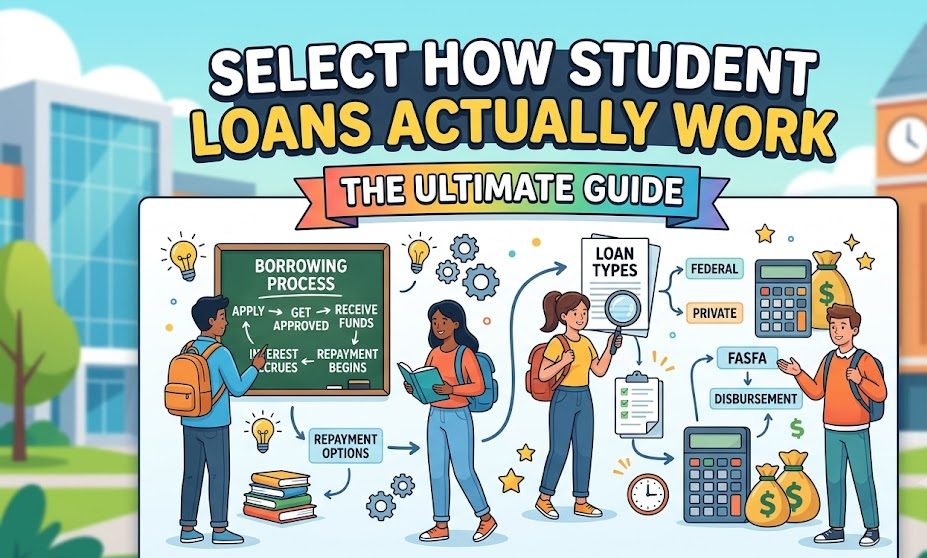
Most students sign their first loan documents at eighteen, half paying attention, mostly relieved that tuition is handled. The real terms of that decision usually don’t become clear until years later — often right around the first repayment bill.
Not all loans behave the same way
Federal loans and private loans are governed by completely different rules, even when the monthly payment looks similar on paper. Federal loans come with fixed rates set by law, access to income-driven repayment plans, and forgiveness programs for certain careers. Private loans are issued by banks or credit unions, can carry variable interest rates, and rarely offer the same flexibility if your income drops.
Private loans
Rates can rise over time, cosigners are often required, and hardship options are decided case-by-case by the lender, not guaranteed by law.
Federal loans
Fixed interest rates, standardized repayment plans, and legal protections that exist regardless of which servicer manages the loan.
Interest starts before you think it does
Unsubsidized federal loans and virtually all private loans begin accruing interest the moment the money is disbursed — not after graduation. That means a loan taken out freshman year has already been quietly growing for four years by the time the first bill arrives, even though no payments were required during school.
The terms hiding in the fine print
- Capitalization
- Unpaid interest gets added to your principal balance at certain points, meaning future interest is then charged on a larger number.
- Grace period
- The window after graduation before payments are due — typically six months for federal loans, but not guaranteed on private ones.
- Cosigner release
- Some private loans allow removing a cosigner after a set number of on-time payments, but only if you formally apply — it isn’t automatic.
- Loan servicer
- The company that manages your payments, which can change without your input and is not the same as who technically owns the loan.
Income-driven repayment isn’t automatic
Federal borrowers can apply for repayment plans that cap monthly payments based on income rather than loan balance, which can be the difference between an affordable bill and a missed one during a rough financial stretch. But these plans require an application and annual recertification — they’re never applied by default, and missing the recertification deadline can spike your payment without warning.
Before signing anything
Ask for the total repayment amount, not just the monthly payment — a lower monthly bill over a longer term can cost significantly more in total interest. Confirm whether the rate is fixed or variable, and read the deferment and hardship terms before you need them, not after.
Refinancing isn’t always the win it sounds like
Refinancing federal loans into a private loan can lower your interest rate, but it also permanently gives up federal protections like income-driven repayment and forgiveness eligibility. That trade can make sense for someone with stable, high income and no interest in those programs — but it’s not reversible once done, so it deserves real thought rather than a quick decision based on rate alone.
Missing payments has more consequences than a late fee
Federal student loans don’t go through the same default process as credit cards — wage garnishment and tax refund interception are legally possible without a court order in some cases. Reaching out to your servicer the moment a payment becomes difficult, rather than after missing several, opens far more options for adjusting your plan before things escalate.
Borrow only what you’ll actually need
Loan offers are often larger than the true cost of tuition, books, and housing, and it’s tempting to accept the full amount and treat the leftover as spending money. Every extra dollar borrowed carries interest for years, so it’s worth building an honest budget before accepting an offer rather than defaulting to whatever the school suggests.
None of this means student loans are inherently a bad decision — for many people, they’re what makes a degree and the income increase that follows possible at all. But signing without understanding how interest compounds, what protections you’re keeping or giving up, and what your actual total repayment will look like is how a manageable loan quietly turns into a decades-long weight. Five minutes reading the terms now saves years of surprise later.