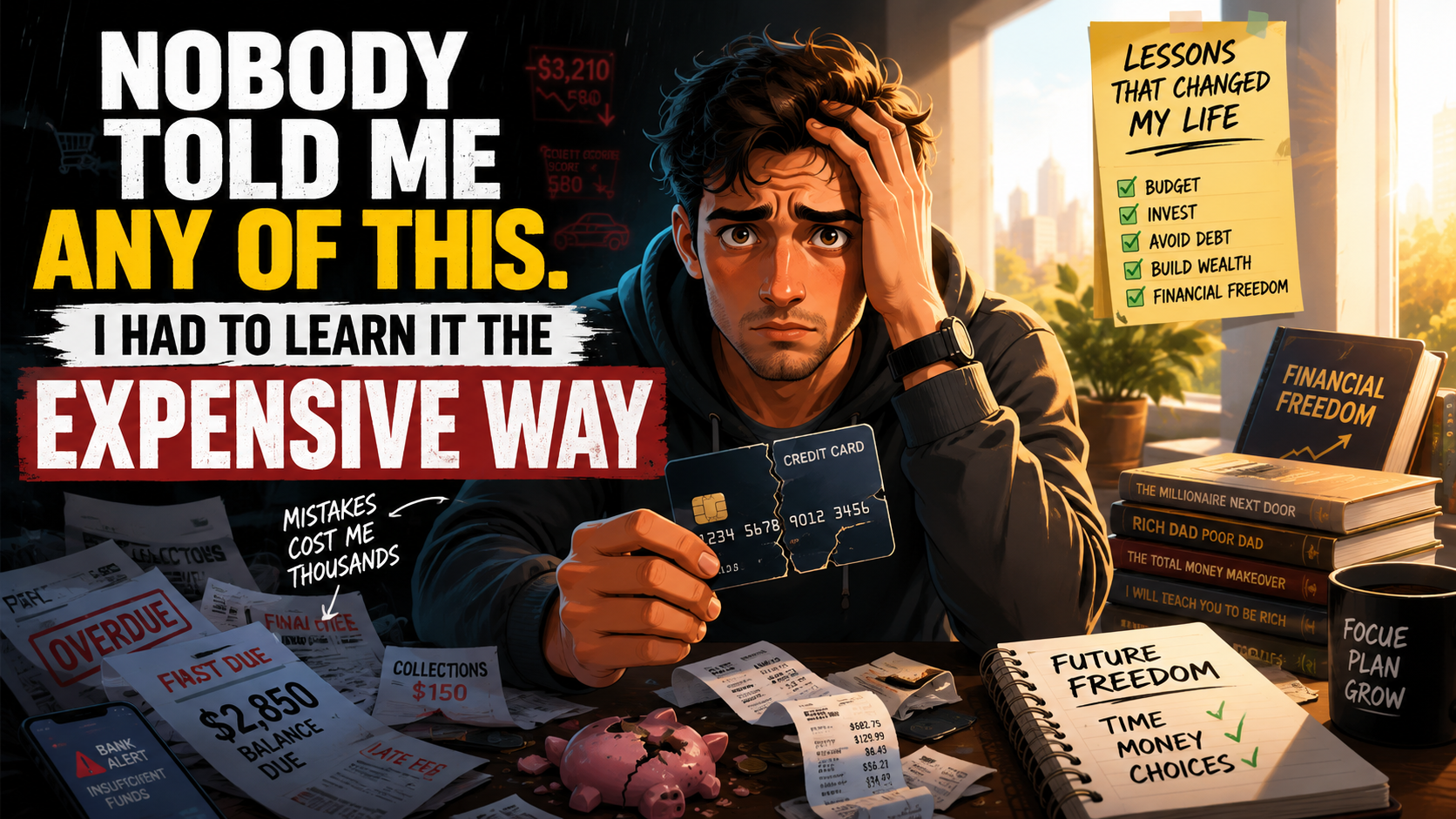
I remember the exact moment I realized I had no idea what I was doing with money:)
I was 26, sitting in a car dealership, signing paperwork for a $31,000 SUV. The finance guy slid a sheet across the desk showing my monthly payment — $489 for 72 months.
I thought: yeah, I can do $489 a month. That’s fine.
What I didn’t think about: 72 months is six years. Six years of $489 is $35,208. On a $31,000 car. Plus insurance. Plus gas. Plus the two repairs I’d need before it was paid off.
I signed anyway.
That SUV cost me more than my first year of college. And unlike college, it was worth exactly nothing by the time I finished paying for it.
That’s the day I started actually paying attention to money. Not because I read a book or watched a YouTube video. Because I made an expensive mistake and finally got angry enough to figure out why.
Here’s everything I’ve learned since then — the stuff that doesn’t show up in most finance articles because it’s not clean or inspirational. It’s just true.
➜ 💸 The Thing About Money Nobody Wants to Say 🙂
Money is emotional. Full stop.
Every finance book, every podcast, every Reddit thread about personal finance talks about money like it’s math. Like if you just understand the numbers, you’ll make good decisions.
But you don’t eat because you’re hungry. You eat because you’re bored, stressed, celebrating, or sad. You don’t spend money because you need things. You spend because you’re tired after work and your phone is full of things that are one tap away.
The math of personal finance is genuinely simple. Spend less than you earn. Invest the difference. Wait.
That’s it. That’s the whole thing.
But if it were just math, nobody would have credit card debt. Nobody would lease a car they can’t afford. Nobody would have four streaming services and use one.
The reason most financial advice doesn’t stick is because it addresses the math and ignores the human being doing the math.
So before the tips, before the strategies — understand this about yourself: you are going to make emotional decisions about money. Everyone does. The goal isn’t to become a robot. The goal is to build enough structure around your finances that your emotional decisions can’t do that much damage.
➜ 🔧 What I Actually Changed — And What Made a Difference 🙂
I’m not going to give you a theory. I’m going to tell you exactly what I did, what worked, and what didn’t.
➤ What Didn’t Work: Budgeting Apps
I downloaded every budgeting app available. Mint (RIP), YNAB, Personal Capital, a spreadsheet I made at 11pm on a Sunday and abandoned by Wednesday.
The problem wasn’t the apps. The problem was that tracking spending after the fact doesn’t stop the spending. It just makes you feel guilty about it with better graphs.
Tracking where your money went is useful information. But information alone doesn’t change behavior. I knew I was spending $340 a month on restaurants. Seeing it in a pie chart every month didn’t make me stop. It just made me feel bad while I kept doing it.
➤ What Did Work: Automating Savings Before I Could Touch It
The change that actually moved the needle was stupidly simple.
I set up an automatic transfer for $400 to move from my checking account to a high-yield savings account on the same day my paycheck deposited. Before I opened my banking app. Before I checked my balance. Before I had any idea the money was there.
Within three months I had $1,200 saved. I hadn’t tried harder or been more disciplined. I’d just removed the decision entirely.
This is the most underrated move in personal finance. Not investing strategy. Not budgeting systems. Just automating savings so your future self benefits from money your present self never gets attached to.
➤ What Did Work: Cutting One Dumb Expense I Actually Noticed
I had a gym membership at a nice gym. $85 a month. I went maybe twice in four months.
I knew I wasn’t going. I kept paying anyway because canceling felt like admitting failure. Like if I canceled, I was officially giving up on being a person who works out.
That’s not a financial decision. That’s ego. And it was costing me $1,020 a year.
I canceled. I started running outside. I felt zero difference in my life except I had $85 more a month.
Find your version of that gym membership. Everyone has one. Usually more than one.
➜ 💳 The Credit Score Game — Play It or Pay for Ignoring It 🙂
Your credit score affects more of your daily life than you probably realize.
Apartment applications. Car loan rates. Sometimes job applications. Even the interest rate on a credit card you already have can go up if your score drops.
And the frustrating thing is that the game has almost nothing to do with how responsible you are with money in real life. You can be genuinely careful with every dollar and have a mediocre credit score because you have no credit history. Meanwhile someone who spends recklessly but always pays their minimum on time can have an 780.
So learn the actual rules:
- ➤ Payment history is 35% of your score. One missed payment can drop your score 50-100 points. Set every bill to autopay for at least the minimum. This alone protects most of your score.
- ➤ Credit utilization is 30%. This is how much of your available credit you’re using. Keep it under 30%, ideally under 10%. If your card limit is $5,000, try to have less than $500 on it when your statement closes.
- ➤ Length of history matters. Don’t close old credit cards even if you don’t use them. An old card with a zero balance is helping your score by existing.
- ➤ Hard inquiries hurt temporarily. Every time you apply for new credit, your score dips a little. Don’t apply for five cards in a month.
That’s the whole game. It’s not complicated. It’s just not explained anywhere.
➜ 🏦 The Savings Account Trap Most Americans Fall Into 🙂
Quick question — what interest rate is your savings account paying right now?
If you bank at Chase, Bank of America, Wells Fargo, or most major traditional banks — the answer is probably 0.01%. Sometimes literally that.
At 0.01%, $10,000 in savings earns you exactly one dollar per year.
Meanwhile, high-yield savings accounts at online banks like Ally, Marcus by Goldman Sachs, or SoFi are currently paying around 4.5% APY. Same money, same FDIC insurance, same accessibility.
$10,000 at 4.5% earns $450 a year. That’s $449 more than your current bank is giving you. For doing nothing except opening a different account.
This is not a trick. It’s not complicated. Traditional banks just count on most people never comparing rates or thinking to move their money.
Move your emergency fund to a high-yield savings account. It takes 15 minutes. It costs nothing. And your money actually grows while it sits there waiting for something to go wrong.
➜ 📈 Why Your 20s and 30s Are Actually the Most Important Decade for Money 🙂
Not because of discipline. Not because of sacrifice.
Because of time.
Here’s a number I wish someone had shown me at 22.
If you put $5,000 into an S&P 500 index fund at age 22 and never touch it — not another dollar added, just that one $5,000 — by age 65 at an average 8% annual return, that $5,000 becomes approximately $147,000.
One. Single. Investment.
That’s not motivation poster math. That’s compound interest being boring and relentless over 43 years.
Now flip it. Wait until you’re 35 to make that same $5,000 investment. By 65, it grows to about $50,000.
Same money. Same market. Thirteen fewer years. $97,000 less.
Nobody explains this when you’re 22 and broke and trying to just get through the month. But it’s the most important financial fact of your early life. Time is doing most of the work — but only if you start.
You don’t need much. A Roth IRA at Fidelity or Vanguard, a few hundred dollars, an S&P 500 index fund. That’s the whole setup. It takes one afternoon to open and fund an account. Then you mostly leave it alone.
The enemy isn’t laziness. The enemy is waiting until you feel “ready.” That feeling never comes. Just start with whatever you have.
➜ 🛒 The Daily Life Part — Where Most Money Actually Goes 🙂
Big financial decisions matter. But they happen occasionally.
Daily life happens every day.
And daily life, for most Americans, involves a pattern something like this: coffee on the way to work, lunch out because there was nothing easy to pack, a few taps on Amazon or DoorDash in the evening, a streaming service playing in the background, and a credit card that catches the overflow.
None of it feels significant. All of it adds up.
The number that surprises most people when they actually look: food spending. Groceries plus restaurants plus delivery plus coffee plus work lunches — for a single person living alone, $900 to $1,400 a month is common. Sometimes more.
That number can absolutely be worth it. Food is one of the real pleasures of life. Great restaurants are worth it. Cooking good meals is worth it.
But $1,200 a month spent mostly on forgettable convenience food, ordered while tired, eaten distracted — that’s a different thing entirely.
The question isn’t whether to spend money on food. The question is whether you’re actually enjoying what you’re spending, or just executing habits on autopilot.
That question applies to every category of daily spending. Not to create guilt. To create awareness. There’s a real difference between spending deliberately and spending because that’s just what happens.
➜ ✅ Three Moves. This Month. Non-Negotiable. 🙂
➤ Move One — Find your emergency fund and put it somewhere that earns money.
Open a high-yield savings account if you don’t have one. Move your existing emergency fund there. If you don’t have an emergency fund, start one with whatever you can — $200, $500, doesn’t matter. The habit is the point. The account is at Ally or Marcus. Done.
➤ Move Two — Check if you’re getting your full 401(k) match at work.
Log into your HR portal right now. If your employer matches 3% and you’re contributing 2%, you’re leaving free money on the table every single paycheck. Increase your contribution to at least the match amount. This might be the single highest-return financial move available to you.
➤ Move Three — List every subscription you pay for.
Every single one. Go through your last two months of bank and credit card statements. Write them all down. Cancel anything you haven’t used in 30 days. Do this before the weekend is over.
Three moves. Probably two hours total. Potentially worth thousands of dollars a year.
➜ 🧠 The Part Where I Tell You the Thing That Actually Matters 🙂
I’ve read a lot of personal finance content. I’ve tried a lot of systems.
And the honest truth is that most of it misses what actually changes people’s financial lives.
It’s not the perfect budget. It’s not the optimal investment allocation. It’s not even the right savings rate.
It’s the moment you stop treating money as something that just happens to you.
When you go from “I never have money left at the end of the month” to “I wonder where it’s going” — that’s the shift. Everything else follows from there.
You’ll make mistakes. The car dealership version of a mistake, the credit card version, the “I should have invested that money” version. Everyone does. The goal isn’t a perfect track record.
The goal is to get better. Slowly, consistently, one small decision at a time.
You’re already doing that. You read this whole thing.
That counts.
➜ ❓ FAQ 🙂
➤ Q: I have nothing saved and I’m in my 30s. Is it too late?
No. Stop asking that question — it keeps people paralyzed. The second best time to start is today. Someone who starts saving and investing at 35 and stays consistent will end up in a dramatically better position than someone who never starts. The math still works. It just requires slightly more contribution to make up ground.
➤ Q: What’s the one financial book actually worth reading?
The Psychology of Money by Morgan Housel. Not because of the strategies — because it’s the most honest book about how humans actually relate to money, which is where most financial decisions actually get made or broken.
➤ Q: How do I get out of credit card debt when I’m living paycheck to paycheck?
The math says: list every card by interest rate, pay minimums on all, throw every extra dollar at the highest rate card first. The reality says: find one expense to cut or one way to earn extra this month, even temporarily. The problem with paycheck-to-paycheck debt payoff is there’s no margin. You have to create some, even a little, before the math can work.
➤ Q: Does where I live really affect my finances that much?
More than almost anything else. Someone earning $60,000 in Raleigh, NC lives a financially different life than someone earning $60,000 in San Francisco. Cost of living differences across US cities are enormous — housing especially. If you have flexibility in where you live, it’s one of the highest-leverage financial decisions available.
➤ Q: I understand all this but I can’t seem to actually do it. What’s wrong with me?
Nothing. Knowing and doing are genuinely different skills. The most effective thing: make the right action the default. Automate savings. Set autopay. Delete shopping apps from your phone. Make the good behavior require zero willpower because it’s already set up. And make the bad behavior require friction. The goal isn’t to become more disciplined. It’s to need less discipline.