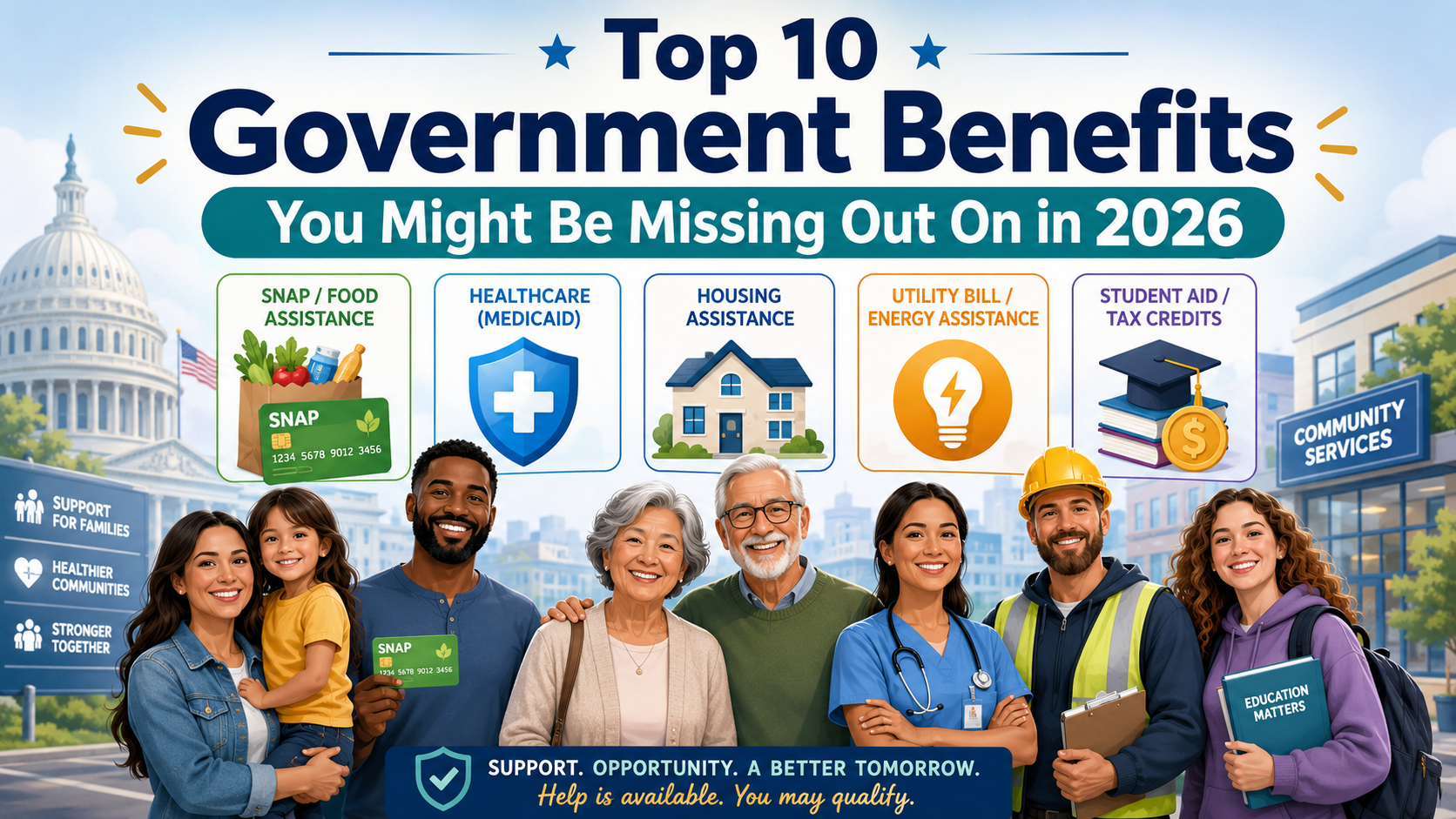
Millions of Americans qualify for government assistance but never apply. Some assume their income is too high, while others do not realize that working families, students, older adults, parents and people with disabilities may qualify for different programs.
Government benefits are not limited to monthly cash payments. Assistance may come through food benefits, affordable healthcare, rent subsidies, utility discounts, refundable tax credits, educational grants or reduced phone and internet bills. Eligibility depends on factors such as income, household size, age, disability, state of residence and family circumstances.
Government benefits are not limited to monthly cash payments. Assistance may come through food benefits, affordable healthcare, rent subsidies, utility discounts, refundable tax credits, educational grants or reduced phone and internet bills. Eligibility depends on factors such as income, household size, age, disability, state of residence and family circumstances.
Quick Comparison: Government Benefits Available in 2026
| Program | Main Assistance | Designed For |
|---|---|---|
| SNAP | Monthly food assistance | Low-income households |
| Medicaid and CHIP | Free or low-cost healthcare | Adults, children and families |
| Premium Tax Credit | Reduced insurance premiums | Marketplace applicants |
| SSI | Monthly cash assistance | Older, blind or disabled people |
| Housing Choice Voucher | Help paying rent | Eligible low-income renters |
| LIHEAP | Energy-bill assistance | Households with high utility costs |
| WIC | Food and nutrition support | Pregnant people and young children |
| Lifeline | Phone or internet discount | Qualifying low-income households |
| EITC | Refundable tax credit | Low-to-moderate-income workers |
| Federal Pell Grant | College financial aid | Eligible undergraduate students |
1. Supplemental Nutrition Assistance Program
The Supplemental Nutrition Assistance Program, commonly known as SNAP, provides eligible households with money for groceries through an Electronic Benefits Transfer card. Benefits can generally be used for fruits, vegetables, meat, dairy products, bread, cereals and other approved foods.
For fiscal year 2026, the basic federal gross-income test in the 48 contiguous states and Washington, D.C. is generally 130% of the federal poverty level, although deductions, household circumstances and state rules can affect eligibility. The 2026 standards apply from October 1, 2025, through September 30, 2026.
For fiscal year 2026, the basic federal gross-income test in the 48 contiguous states and Washington, D.C. is generally 130% of the federal poverty level, although deductions, household circumstances and state rules can affect eligibility. The 2026 standards apply from October 1, 2025, through September 30, 2026.
2. Medicaid and CHIP Healthcare Coverage
Medicaid provides free or low-cost healthcare to qualifying adults, families, pregnant women, older adults and people with disabilities. In states that expanded Medicaid, many adults may qualify based mainly on household income, generally up to an effective 138% of the federal poverty level.
CHIP helps insure children whose families earn too much for Medicaid but may still struggle with private insurance costs. You can apply for Medicaid or CHIP throughout the year rather than waiting for an annual enrollment period. Eligibility and covered services vary by state.
CHIP helps insure children whose families earn too much for Medicaid but may still struggle with private insurance costs. You can apply for Medicaid or CHIP throughout the year rather than waiting for an annual enrollment period. Eligibility and covered services vary by state.
3. Health Insurance Premium Tax Credit
Households that do not qualify for Medicaid and lack affordable employer-sponsored coverage may be eligible for a Premium Tax Credit when purchasing insurance through the Health Insurance Marketplace.
For 2026, eligibility generally requires household income between 100% and 400% of the federal poverty line, along with other tax and coverage requirements. The credit can be applied in advance to reduce monthly premiums, but applicants should estimate their annual income carefully because the final amount is reconciled on their federal tax return.
For 2026, eligibility generally requires household income between 100% and 400% of the federal poverty line, along with other tax and coverage requirements. The credit can be applied in advance to reduce monthly premiums, but applicants should estimate their annual income carefully because the final amount is reconciled on their federal tax return.
4. Supplemental Security Income
Supplemental Security Income, or SSI, provides monthly assistance to people who are older, blind or disabled and have limited income and financial resources. It is different from Social Security retirement because eligibility is based primarily on financial need rather than a person’s complete employment record.
After the 2.8% cost-of-living adjustment, the maximum federal SSI payment standard for 2026 is $994 per month for an eligible individual and $1,491 for an eligible couple. Actual payments may be lower depending on income, living arrangements and state supplements.
After the 2.8% cost-of-living adjustment, the maximum federal SSI payment standard for 2026 is $994 per month for an eligible individual and $1,491 for an eligible couple. Actual payments may be lower depending on income, living arrangements and state supplements.
5. Housing Choice Voucher Program
The Housing Choice Voucher Program, often called Section 8, helps qualifying low-income households rent eligible homes in the private market. A local Public Housing Agency generally pays part of the approved rent directly to the landlord, while the household pays its required share.
Eligibility is based on local income limits, family size, citizenship or eligible immigration status and other program rules. Waiting lists can be long, so applicants may benefit from checking multiple Public Housing Agencies rather than relying on only one location.
Eligibility is based on local income limits, family size, citizenship or eligible immigration status and other program rules. Waiting lists can be long, so applicants may benefit from checking multiple Public Housing Agencies rather than relying on only one location.
6. Low Income Home Energy Assistance Program
LIHEAP can help eligible households pay heating or cooling bills, receive emergency energy assistance and, in some locations, avoid utility disconnection. Certain programs may also support weatherization or minor energy-related home improvements.
Income limits, application periods and available funding differ by state, territory and tribe. Because funding can be limited, applying early through the local LIHEAP office may improve the chance of receiving assistance.
Income limits, application periods and available funding differ by state, territory and tribe. Because funding can be limited, applying early through the local LIHEAP office may improve the chance of receiving assistance.
7. WIC Nutrition Benefits
The Special Supplemental Nutrition Program for Women, Infants and Children provides healthy foods, nutrition education, breastfeeding support and healthcare referrals. It serves qualifying pregnant people, postpartum parents, breastfeeding parents, infants and children younger than five.
Applicants who already receive Medicaid, SNAP or Temporary Assistance for Needy Families may automatically meet WIC’s income requirement. Other applicants are evaluated using household income and a simple nutrition assessment.
Applicants who already receive Medicaid, SNAP or Temporary Assistance for Needy Families may automatically meet WIC’s income requirement. Other applicants are evaluated using household income and a simple nutrition assessment.
8. Lifeline Phone and Internet Discount
Lifeline is a federal benefit that reduces the cost of qualifying phone or internet service. Eligible subscribers can receive a discount of up to $9.25 per month, while qualifying residents of Tribal lands may receive up to $34.25 per month.
A household may qualify through income or participation in programs such as SNAP, Medicaid or SSI. The discount is generally limited to one Lifeline benefit per household, not one benefit for every household member.
A household may qualify through income or participation in programs such as SNAP, Medicaid or SSI. The discount is generally limited to one Lifeline benefit per household, not one benefit for every household member.
9. Earned Income Tax Credit
The Earned Income Tax Credit is a refundable federal tax credit for qualifying workers with low or moderate income. Refundable means an eligible person may receive money back even when the credit is greater than the federal income tax they owe.
For tax year 2026, the maximum EITC ranges from $664 for an eligible filer without qualifying children to $8,231 for a filer with three or more qualifying children. Workers must file a federal tax return to claim it, even when they are not otherwise required to file.
For tax year 2026, the maximum EITC ranges from $664 for an eligible filer without qualifying children to $8,231 for a filer with three or more qualifying children. Workers must file a federal tax return to claim it, even when they are not otherwise required to file.
10. Federal Pell Grant
The Federal Pell Grant helps eligible undergraduate students pay for college or career school. Unlike a student loan, a Pell Grant normally does not need to be repaid, provided the student continues meeting program requirements.
The maximum Pell Grant for the 2026–27 award year is $7,395. The amount a student receives depends on financial need, enrollment intensity, attendance costs and the length of the academic year. Students must complete the Free Application for Federal Student Aid to be considered.
The maximum Pell Grant for the 2026–27 award year is $7,395. The amount a student receives depends on financial need, enrollment intensity, attendance costs and the length of the academic year. Students must complete the Free Application for Federal Student Aid to be considered.
How to Find Benefits You Qualify For
➜ Do not assume your income is too high: Different programs use different income calculations and deductions.
➜ Apply separately when necessary: Receiving one benefit does not automatically enroll you in every other program.
➜ Gather essential documents: Keep identification, Social Security numbers, income records, rent statements, utility bills and household information ready.
➜ Report accurate information: Changes in income, address or household size can affect eligibility.
➜ Use official government websites: Government agencies do not normally require gift cards, wire transfers or large advance payments to process benefit applications.
➜ Apply separately when necessary: Receiving one benefit does not automatically enroll you in every other program.
➜ Gather essential documents: Keep identification, Social Security numbers, income records, rent statements, utility bills and household information ready.
➜ Report accurate information: Changes in income, address or household size can affect eligibility.
➜ Use official government websites: Government agencies do not normally require gift cards, wire transfers or large advance payments to process benefit applications.
Frequently Asked Questions
Can working people receive government benefits?
Yes. Programs such as SNAP, WIC, Medicaid, Marketplace tax credits and the EITC can serve eligible working households. Having employment does not automatically make someone ineligible.
Can I receive more than one benefit?
Possibly. A household may qualify for several programs at the same time. For example, participation in SNAP or Medicaid may also help establish income eligibility for WIC or Lifeline.
Will government benefits affect my credit score?
Receiving ordinary public benefits does not generally appear as debt on a credit report. However, applicants must follow reporting and repayment rules if an agency later determines that an overpayment occurred.
Are benefit amounts the same in every state?
No. Some programs use federal standards, while others are administered by states, tribes, territories or local agencies. Income limits, payment amounts, waiting lists and application procedures may therefore differ.
Where should I begin?
Start with your state’s official social-services agency, local Public Housing Agency, Health Insurance Marketplace application or the federal Benefits Finder. Avoid websites that promise guaranteed approval in exchange for payment.
Final Thoughts
Government assistance in 2026 extends far beyond traditional welfare checks. Food support, healthcare coverage, rent assistance, energy relief, tax refunds, educational grants and communication discounts can all reduce essential household expenses.
The most important step is checking eligibility instead of assuming you will be rejected. Apply through official agencies, submit complete documents and keep copies of every application. Even one overlooked program could meaningfully reduce your monthly expenses and provide greater financial stability.
The most important step is checking eligibility instead of assuming you will be rejected. Apply through official agencies, submit complete documents and keep copies of every application. Even one overlooked program could meaningfully reduce your monthly expenses and provide greater financial stability.
Disclaimer: This article is for general informational purposes and does not guarantee eligibility or payment. Program requirements, funding and benefit amounts may change. Confirm current information with the responsible federal, state or local agency before applying.