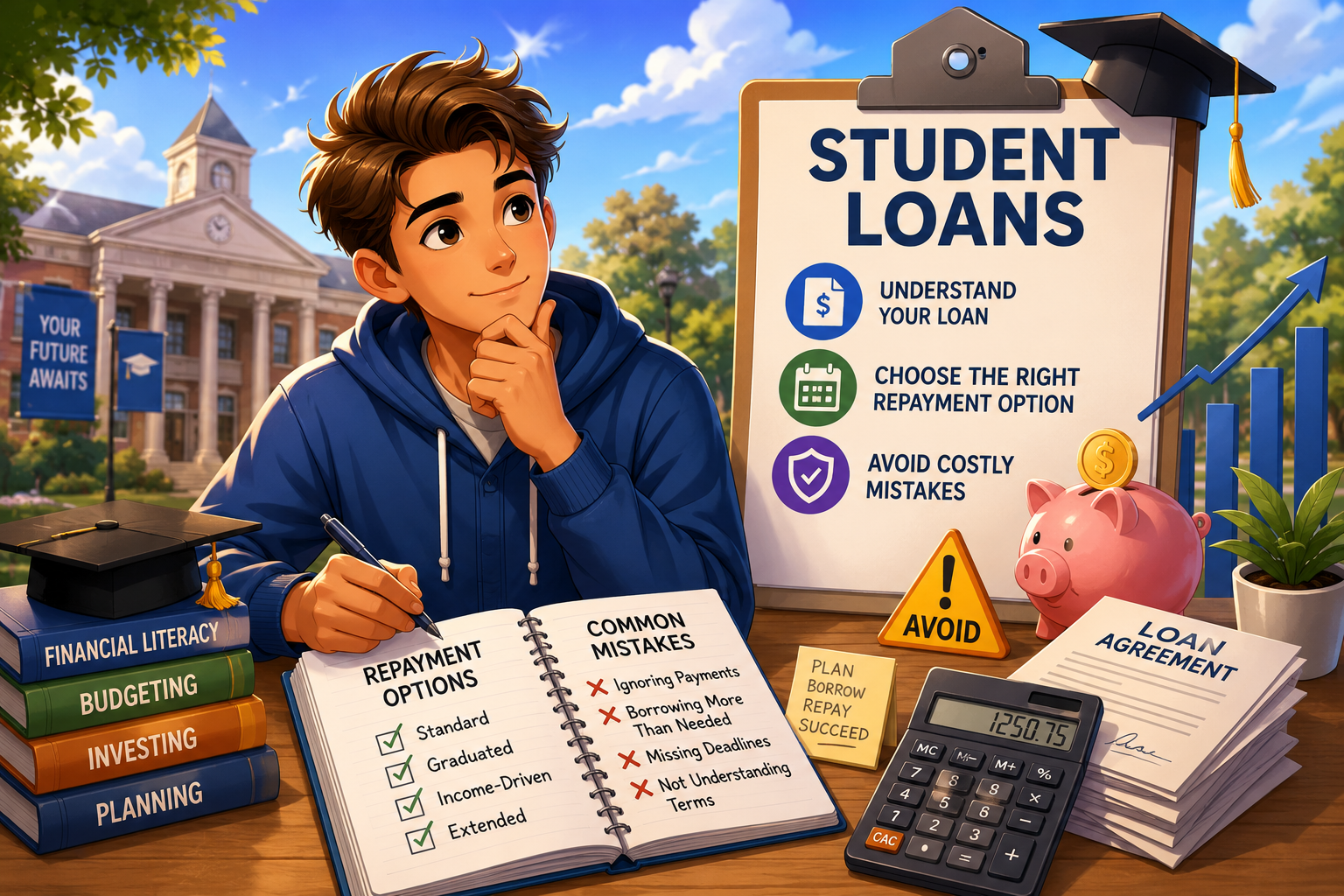
Understand how student loans work, compare borrowing choices, explore repayment approaches and learn how to avoid decisions that may increase the long-term cost of education.
Higher education can create valuable career opportunities, but tuition fees, accommodation, books, transport and everyday living expenses can make college difficult to afford. Student loans help eligible students cover these costs by allowing them to borrow money and repay it later.
Borrowing can be useful, but every loan creates a financial responsibility. Interest may increase the total amount owed, repayment may continue for years, and missed payments may affect a borrower’s finances. Students should therefore understand the loan terms before accepting funds.
What Is a Student Loan?
A student loan is money borrowed specifically to pay for education-related expenses. The borrower normally receives funds while studying and begins or continues repayment according to the lender’s agreement.
The original amount borrowed is called the principal. The additional cost charged for borrowing that money is called interest. Depending on the loan, interest may begin accumulating immediately or may receive special treatment during certain eligible periods.
- Principal: The original amount borrowed.
- Interest rate: The percentage used to calculate borrowing costs.
- Loan term: The period provided for repayment.
- Servicer or lender: The organisation that manages billing and payments.
- Grace period: A possible period before required repayment begins.
Federal and Private Student Loans
In the United States, student loans generally fall into two broad categories: federal loans and private loans. They may appear similar, but their eligibility rules, protections, interest structures and repayment choices can be different.
| Feature | Federal Loans | Private Loans |
|---|---|---|
| Lender | Government-backed student-aid programme | Bank, credit union or private finance company |
| Interest structure | Federal loans generally use a fixed rate for the life of an individual loan. | May have a fixed or variable rate, depending on the agreement. |
| Credit check | Not required for some common undergraduate federal loans. | Credit history commonly affects approval and pricing. |
| Repayment flexibility | May include several repayment and temporary-relief options. | Options depend on the individual lender and contract. |
| Best starting point | Often considered before private borrowing when the student is eligible. | May help fill a remaining education funding gap. |
Federal Student Aid explains that federal Direct Subsidized and Direct Unsubsidized Loans are designed to help eligible students pay for college or career-school costs. It also notes that federal loan interest rates are fixed for the life of each loan, although the applicable rate varies by loan type and disbursement date.
Subsidized and Unsubsidized Loans
Direct Subsidized Loans
Subsidized loans are available to eligible undergraduate students with demonstrated financial need. Under qualifying conditions, the government covers interest during certain periods, which may reduce the amount the student eventually pays.
Direct Unsubsidized Loans
Unsubsidized loans may be available to eligible undergraduate, graduate and professional students. The borrower is generally responsible for the interest that accumulates, including interest that may build while the student is in school.
How Much Should a Student Borrow?
A student may be offered more loan money than is immediately necessary. Accepting the full amount can be tempting, but borrowed money must eventually be repaid with any applicable interest.
Before borrowing, prepare a realistic education budget covering:
- Tuition and required institutional fees
- Books, software and course materials
- Housing and utilities
- Food and essential personal expenses
- Transport and necessary travel
- Health coverage and emergency costs
Then subtract scholarships, grants, savings, family support and realistic employment income. The remaining funding gap provides a more useful borrowing target than the maximum amount offered.
Repayment Options Explained
Repayment arrangements determine how much a borrower pays each month and how long the loan may remain outstanding. The available choices depend on the loan type, balance, borrower eligibility and current programme rules.
| Repayment Approach | How It Generally Works | Important Consideration |
|---|---|---|
| Standard repayment | Uses generally consistent payments designed to repay the balance within a set period. | Higher monthly payments may result in less total interest than a much longer schedule. |
| Graduated repayment | Payments normally start lower and increase over time. | Later payments can become significantly larger. |
| Extended repayment | Spreads payments across a longer period for eligible borrowers. | Smaller monthly payments may lead to a higher total interest cost. |
| Income-driven repayment | For eligible federal loans, payments may be calculated using income, household information and programme rules. | Borrowers may need to submit or update required information and should review possible long-term costs. |
| Refinancing | A private lender replaces one or more existing loans with a new private loan. | Refinancing federal debt privately may permanently remove federal protections and benefits. |
Federal Student Aid currently lists several federal repayment plan categories, including standard, graduated, extended and income-driven approaches. Because programme availability and legal requirements can change, borrowers should confirm current options through their official account or loan servicer before making a decision.
What to Do When Payments Become Unaffordable
Ignoring an unaffordable payment usually makes the problem harder to manage. Borrowers should contact their loan servicer as soon as possible, preferably before a payment is missed.
- Review the loan account. Confirm the balance, due date, interest rate and current repayment arrangement.
- Contact the servicer. Explain the financial problem and request information about available alternatives.
- Compare repayment choices. Consider both the immediate monthly payment and the total long-term cost.
- Document communication. Save confirmations, emails, payment records and the names of representatives.
- Continue monitoring. Check statements to confirm that approved changes were applied correctly.
The Consumer Financial Protection Bureau advises borrowers who cannot afford a payment to contact their servicer and ask about affordable repayment arrangements, deferment or forbearance options. These forms of temporary relief can have different costs and eligibility requirements, so the details should be reviewed carefully.
Deferment and Forbearance
Deferment and forbearance may temporarily pause or reduce required payments for borrowers who qualify. They can provide breathing room during unemployment, illness, financial hardship or another eligible situation.
However, a payment pause does not always mean that interest stops. Depending on the loan and relief type, interest may continue accumulating and increase the total balance. These options are normally better treated as temporary tools rather than long-term repayment strategies.
Student Loan Forgiveness and Discharge
Certain federal borrowers may qualify for forgiveness, cancellation or discharge through programmes connected with qualifying employment, eligible repayment history, school-related circumstances, disability or other specific conditions.
Eligibility is not automatic simply because a borrower works in a particular industry or has made payments for several years. Programme rules may require an eligible loan type, qualifying employer, approved repayment arrangement, accurate forms and properly recorded payments.
Borrowers should use official government resources and remain cautious of companies promising immediate forgiveness in exchange for an upfront fee.
Common Student Loan Mistakes to Avoid
Loan eligibility does not mean the full amount is affordable. Borrowing only what is genuinely needed can reduce future financial pressure.
A growing balance can surprise borrowers at graduation. Review statements and learn when interest begins accumulating.
Contact details should remain updated so that important billing, repayment and recertification notices are not missed.
A low payment may help the current budget but can extend repayment and increase the amount paid over time.
Private refinancing may offer a different rate, but it can remove access to federal repayment protections and eligible relief programmes.
Contacting the servicer early usually provides more options than waiting until several payments have already been missed.
Borrowers should be cautious of guaranteed cancellation claims, pressure to act immediately or demands for unnecessary upfront fees.
How to Repay Student Loans More Effectively
- Set up reminders or automatic payments where appropriate.
- Keep an emergency fund so that one unexpected expense does not immediately cause a missed payment.
- Pay more than the required amount when affordable and confirm how extra payments are applied.
- Target higher-interest debt first when choosing between several loans.
- Review repayment options after a major income or household change.
- Check account statements regularly for billing or processing errors.
- Avoid taking new consumer debt simply to maintain an unrealistic student-loan payment.
Borrowers should keep records because servicing mistakes can happen. A CFPB review of borrower complaints identified issues including inaccurate bills, payment-processing problems and incorrect repayment information.
Questions to Ask Before Signing a Loan
- Is the interest rate fixed or variable?
- When does interest begin accumulating?
- Are there origination or other fees?
- When will required repayment begin?
- What would the estimated monthly payment be?
- What is the estimated total repayment amount?
- Are there hardship or income-based options?
- Is a co-signer required?
- How can a co-signer be released, where applicable?
- What happens after a missed payment?
Frequently Asked Questions
1. Are student loans always a bad financial decision?
No. A responsibly chosen loan can help a student complete valuable education. The risk increases when someone borrows excessively, chooses an unaffordable programme or signs terms they do not understand.
2. Should federal or private loans be considered first?
Eligible students commonly review federal aid, grants and scholarships before using private loans because federal loans may provide protections that private contracts do not offer.
3. Can a borrower repay a student loan early?
Many student loans allow additional or early payments, but borrowers should check the agreement and confirm that extra money is applied as intended.
4. Does a longer repayment term reduce the loan cost?
It may reduce the required monthly payment, but it can increase the total interest paid because the balance remains outstanding for longer.
5. What should a borrower do after missing a payment?
Contact the servicer promptly, confirm the account status and ask about available repayment or temporary-relief options. Avoid ignoring notices.
Final Thoughts
Student loans can make education accessible, but they should be treated as a serious long-term financial commitment. Students should compare aid options, borrow only for necessary expenses and understand interest before accepting a loan.
After leaving school, borrowers should select repayment arrangements by considering both monthly affordability and total cost. Maintaining accurate records, communicating with the servicer and requesting help early can prevent manageable financial difficulties from becoming larger problems.
The strongest borrowing decision is not necessarily the loan with the lowest initial payment. It is the option that supports education while keeping future repayment realistic and sustainable.