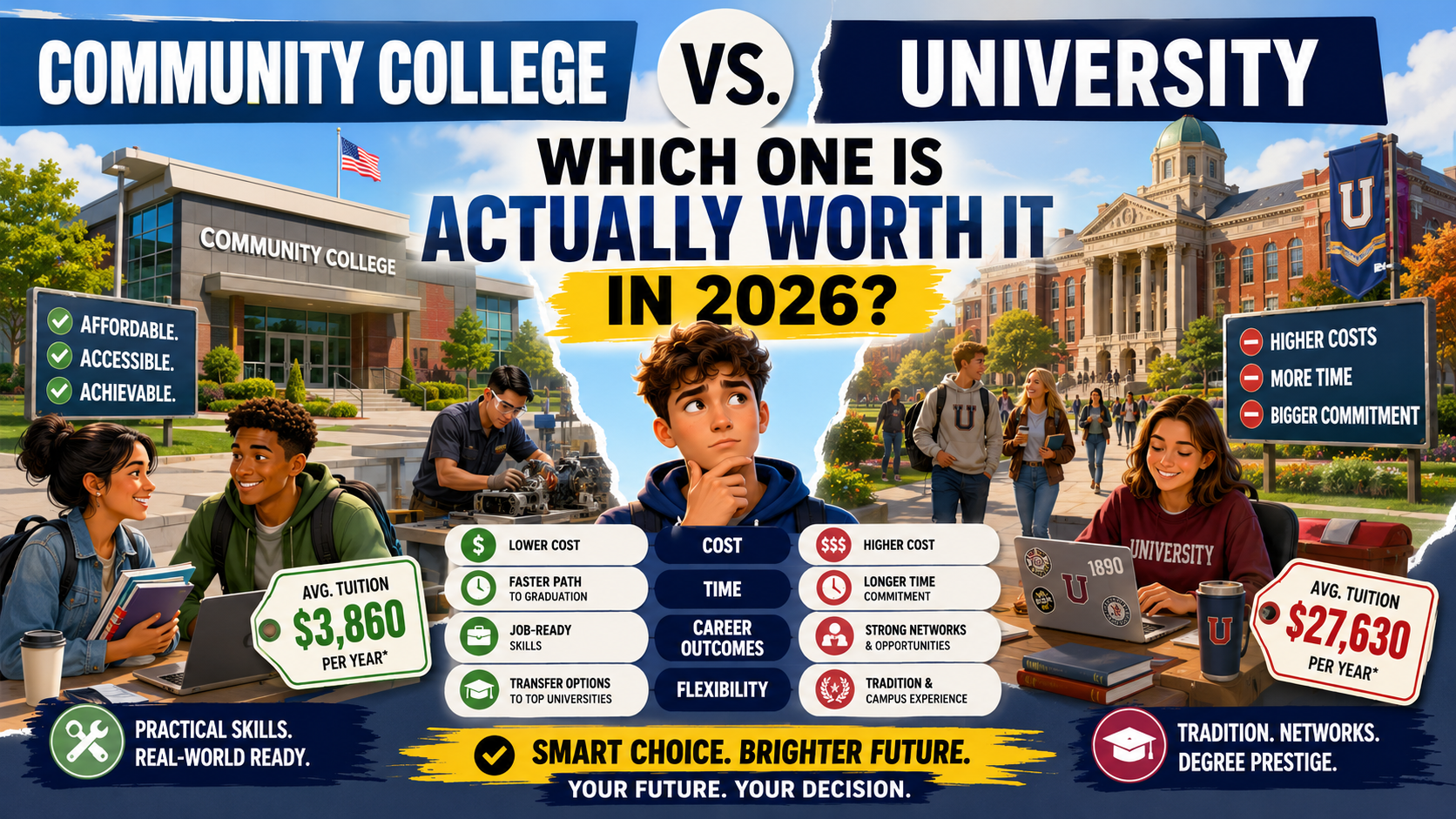
Every spring, families across America face the same question: should a student start at community college or go directly to a four-year university?
The answer is not as simple as people think. One path can save tens of thousands of dollars. The other can offer opportunities that are difficult to replicate elsewhere. The smartest choice depends on your goals, finances, and future plans.
Community College
- 2-Year Associate Degree
- Transfer Pathways
- Flexible Schedules
- Commuter Friendly
- Lower Debt
4-Year University
- Bachelor’s Degree
- Campus Experience
- Research Opportunities
- Networking Access
- Stronger Brand Recognition
💰 01. The Money Argument
The average community college costs around $3,800 per year, while public universities often cost $10,500+ annually for in-state students. Private universities can exceed $50,000 per year before housing and other expenses.
A student who spends two years at community college before transferring can often save between $30,000 and $50,000 while still earning the same bachelor’s degree.
Spend two years at community college, transfer to a university, and graduate with a bachelor’s degree from that university. Same diploma. Much lower debt.
👥 02. Real People, Real Decisions
👩 Destiny — Nurse
Started at community college, completed prerequisites, transferred into nursing school, and graduated with far less debt than friends who chose private universities.
👨 Jordan — Software Engineer
Went directly to a major university and benefited from internships, recruiting events, and networking opportunities that helped secure a job before graduation.
👩 Maria — Teacher
Started at university, switched to community college, then transferred back to finish her bachelor’s degree. The flexible route worked better for her goals.
📊 03. The Real Scorecard
| Category | Community College | University |
|---|---|---|
| Tuition Cost | ✅ Lower Cost | Higher Cost |
| Class Size | ✅ Smaller Classes | Larger Lectures |
| Campus Life | Limited | ✅ Strong Advantage |
| Networking | Moderate | ✅ Strong Advantage |
| Schedule Flexibility | ✅ Better | More Structured |
| Research Opportunities | Limited | ✅ Better |
| Name Recognition | Lower | ✅ Higher |
| Debt After Graduation | ✅ Usually Lower | Usually Higher |
🏛️ 04. When University Is Clearly Better
- ➤ You’re entering a prestige-driven field such as investment banking or certain tech roles.
- ➤ You received major scholarships that reduce your costs significantly.
- ➤ You want the traditional campus experience.
- ➤ Your program requires extensive research opportunities.
🎓 05. When Community College Makes More Sense
- ➤ You’re unsure about your major.
- ➤ You need to work while attending school.
- ➤ You want to minimize student loan debt.
- ➤ You plan to transfer to a university later.
- ➤ You need flexible evening or online classes.
✅ Quick Decision Guide
- Choose Community College: Save money, explore majors, work while studying, or transfer later.
- Choose University: Scholarship opportunities, competitive industries, research access, and full campus life.
- Still Unsure? Visit both campuses, compare actual costs, and talk to current students before deciding.
⚠️ Important Transfer Tip
If you plan to transfer, meet with an academic advisor during your first semester. Not every credit transfers equally. Planning early can save both time and money.
❓ Frequently Asked Questions
Do employers care if you attended community college?
For most careers, employers care more about your degree, skills, and experience than where you completed your first two years.
Can community college students get scholarships?
Yes. Many scholarships specifically target community college and transfer students.
Is an associate degree respected?
Absolutely. Associate degrees have value on their own and can also serve as a pathway toward a bachelor’s degree.
What GPA is needed to transfer?
Many transfer programs require a GPA between 2.0 and 3.0, depending on the university and program.
How long does the transfer process take?
Most students spend two years earning an associate degree and two years completing a bachelor’s degree.
✅ The Honest Verdict
Neither option is automatically better. Community college is not a backup plan, and university is not automatically worth the extra cost.
The students who make the best decision are the ones who compare costs, think about their goals, and choose the path that fits their situation — not someone else’s expectations.
If you’re unsure, starting at community college can be a smart low-risk option. What you can always do is transfer later. What you cannot do is erase unnecessary student loan debt after borrowing it.