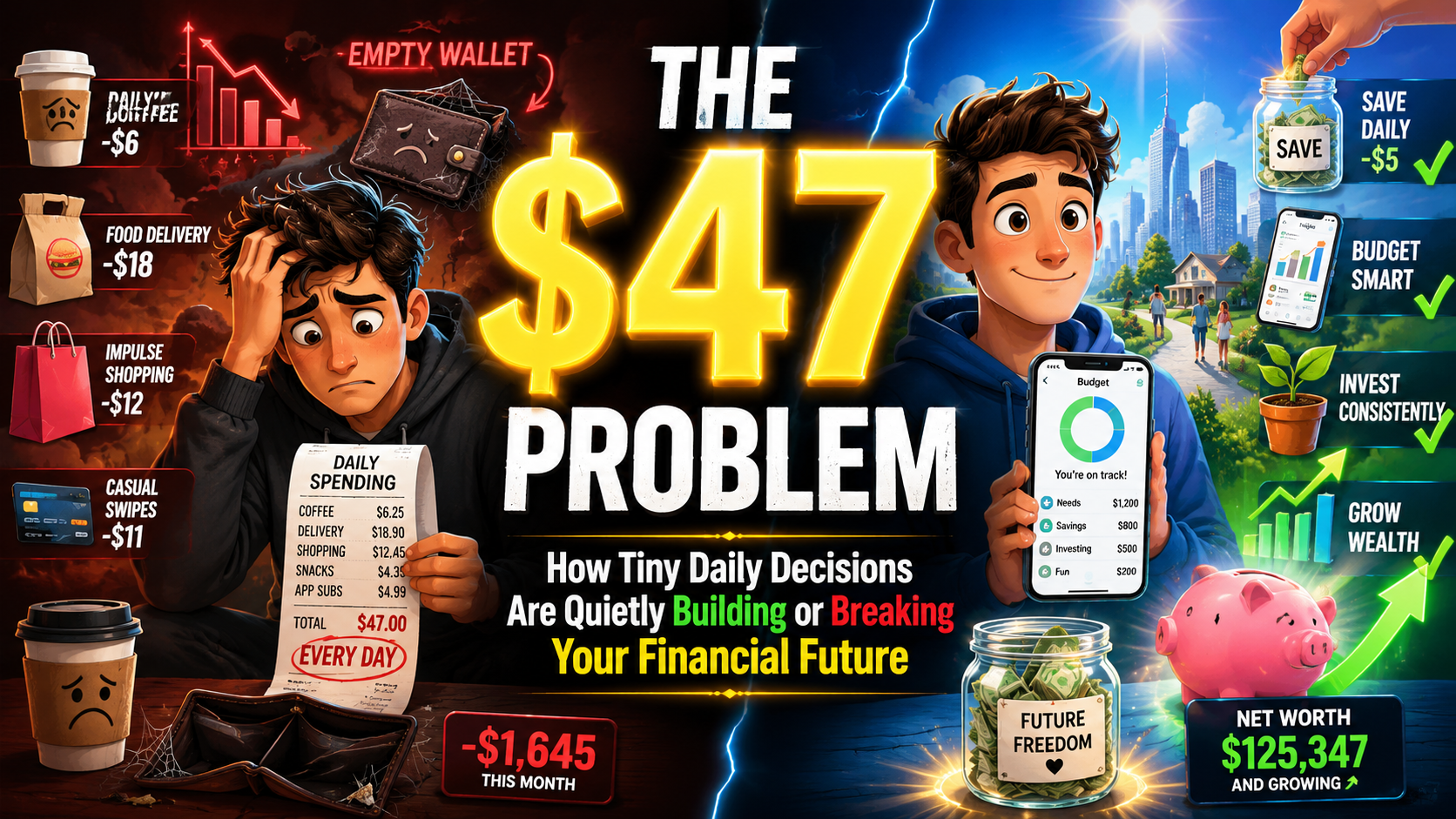
Forty-seven dollars,
That’s the average amount Americans spend on “small, unplanned purchases” every single day according to a 2024 Slickdeals consumer spending report.
<<Not rent. Not groceries. Not bills>>
Just… stuff. The drive-through coffee. The app you downloaded at midnight. The extra items in your cart because free shipping kicks in at $35. The vending machine at 3pm because lunch wasn’t enough.
$47 a day sounds harmless. But $47 a day is $1,410 a month. It’s $16,920 a year. Over a decade, with even modest investment returns, that number becomes something close to $260,000.
Nobody wakes up and decides to throw away a quarter million dollars. But a lot of people are doing it — one small, forgettable purchase at a time.
➜ ☕ The Morning Routine That’s Costing You More Than You Think 🙂
Picture a pretty ordinary Tuesday morning in America.
Alarm goes off. Snooze twice. Shower, get dressed, realize there’s no time to make coffee. Stop at Starbucks — $7.45 for a latte and a breakfast sandwich. Sit in traffic, tap through Instagram on your phone. Maybe grab a parking spot that costs $12 for the day because you left five minutes late and the free lot was full.
That’s $19.45 before 9am. Before you’ve done a single thing.
And here’s the thing — none of those choices feel like financial decisions. They feel like a morning. They feel like life.
That’s exactly the problem.
When money leaves your wallet in small amounts, it doesn’t register as a financial event. Your brain isn’t built to track $6 here and $14 there. It’s built to notice the big stuff — the rent payment, the car payment, the vacation you saved up for.
The small stuff just… evaporates.
➜ 🧠 Small Purchases Are Not the Enemy. Unconscious Spending Is. 🙂
Before this turns into one of those articles that tells you to stop buying coffee — it won’t.
The latte is not the problem. The latte you bought while scrolling your phone and barely tasted, that you don’t even remember an hour later — that’s closer to the problem.
There’s a meaningful difference between spending $7 on a coffee you genuinely enjoy, that’s part of a morning ritual you love, versus spending $7 on a coffee because that’s just what you do when you walk past that corner.
One is a deliberate choice. The other is a habit running on autopilot.
Personal finance in daily life isn’t about restriction. It’s about waking up from autopilot.
➜ 📱 The Invisible Subscriptions Sitting in Your Bank Account Right Now 🙂
Here’s a number that will make you uncomfortable: the average American currently pays for 6.7 subscriptions they actively use, and 2–3 more they’ve forgotten about.
Streaming services. Music. Cloud storage. That meditation app from January. The meal kit service that sends boxes you stopped opening but never cancelled. The premium LinkedIn you signed up for during a job search three years ago.
Pull up your last bank statement. Go line by line. Find every recurring charge.
Most people find somewhere between $80 and $200 a month in subscriptions they’d forgotten. Some find more.
This is the easiest money you will ever save. It takes 20 minutes, it costs you nothing, and you won’t even notice the things you cancel because — by definition — you already forgot they existed.
Do it this weekend. Actually do it.
➜ 🛒 What Grocery Stores Know About You (That You Don’t Know About Yourself) 🙂
The layout of a grocery store is not an accident.
Milk is at the back because you have to walk past everything else to reach it. The expensive items are at eye level. The checkout line is lined with small, cheap, impulse items specifically designed to catch you when your decision-making is tired.
Grocery chains spend millions on behavioral research to understand exactly how Americans shop. They know that people who shop hungry spend 17% more. They know that carts that are too large encourage people to fill them. They know that music tempo affects how quickly you move through the store.
You are walking into a system designed by professionals whose entire job is to get you to spend more than you planned.
The counter-move is simple: shop with a list and don’t deviate. Not because spontaneous purchases are always bad, but because a list puts you back in control of the decision instead of letting the store make it for you.
A grocery list is a financial tool. Not a boring chore — a financial tool.
➜ 💳 The Real Cost of “I’ll Just Put It On the Card” 🙂
American credit card debt crossed $1.13 trillion in 2024. That’s trillion with a T.
And the bulk of it isn’t from emergencies or big purchases. It’s from the same category of spending we’ve been talking about — small, daily, unconsidered expenses that got charged to a card, didn’t get paid off, and started compounding at 22% interest.
Here’s how that math actually works in real life.
Say you carry a $2,500 balance on a credit card at 21% APR. You pay the minimum each month — around $50. At that rate, you’ll spend over six years paying it off, and you’ll pay about $1,900 in interest on top of your original $2,500.
You effectively paid $4,400 for $2,500 worth of stuff you barely remember buying.
This isn’t a lecture. This is just the math. The credit card company is counting on most people not doing it.
➜ ⏳ A Different Way to Think About Daily Spending 🙂
There’s a concept called the “hourly wage test” that changes how a lot of people relate to purchases.
Take your annual salary. Divide it by 2,080 (approximate working hours in a year). That’s roughly your hourly rate.
Now, before a purchase, ask: how many hours of my life did I trade to afford this?
If you earn $50,000 a year, your hourly rate is about $24. That $7 coffee is roughly 17 minutes of work. Fine. A $120 dinner is five hours of your life. Still might be worth it for the right occasion. A $600 impulse purchase is 25 hours — three full work days.
This isn’t about guilt. It’s about making the trade visible. When spending feels abstract — just a tap on a card — it’s easy to lose perspective. Translating it back into time makes the exchange real.
Some things are absolutely worth it. Some things, when you see them in hours instead of dollars, suddenly aren’t.
➜ 🏠 Building a Financial Life Around Your Actual Daily Routine 🙂
Here’s something the standard personal finance advice misses: your financial habits have to fit your life as it actually is, not as you wish it were.
If you drive past a Starbucks every morning, telling yourself you’ll stop going is probably a losing strategy. The environment wins. Instead, load your Starbucks app with a fixed monthly amount. When it’s gone, it’s gone. You’re not eliminating the habit — you’re capping it.
If you impulse shop online when you’re bored at night, install a browser extension like Honey or use Amazon’s “save for later” button. Add friction between the urge and the purchase. Most impulse buying disappears with just a little delay.
If you eat out a lot because cooking after work feels impossible, stop trying to become a meal prepper overnight. Start with one dinner a week at home. Then two. The goal is direction, not perfection.
Good financial habits are built by working with your life, not against it.
➜ 🔢 The 3 Numbers That Should Live on Your Phone 🙂
➤ Number 1 — What came in this month
Your actual take-home after taxes. Not your salary. What actually deposited.
➤ Number 2 — What went out on fixed expenses
Rent, car, insurance, subscriptions. The stuff that happens whether you decide anything or not.
➤ Number 3 — What’s left
This is your breathing room. Everything you spend on food, fun, gas, and life comes out of this number.
Most people go through entire months without knowing Number 3. Then they wonder why the account is low. Knowing this number, even roughly, changes behavior without requiring any willpower. You make different decisions when you know how much runway you have.
➜ 💡 The Version of Personal Finance Nobody Talks About 🙂
Every personal finance article eventually gets to investing, compound interest, index funds. And those things matter — a lot.
But there’s a version of financial health that happens before all of that, in the hours and minutes of an ordinary day, that barely gets discussed.
It’s in whether you check your balance before a night out or just hope for the best. It’s in whether you notice the gym membership you’ve been paying for since February. It’s in the half-second pause before you tap your card — not to deny yourself, just to ask if this is actually what you want.
That level of awareness doesn’t make you cheap. It doesn’t make you obsessed with money. It makes you someone who’s conscious of one of the most powerful forces shaping your daily life.
The people who are genuinely good with money aren’t usually the ones with the most discipline. They’re the ones who made good decisions automatic — through systems, through habits, through small design choices in their environment — so they don’t have to rely on willpower at all.
The goal is to make your daily life and your financial goals point in the same direction. When they do, building wealth stops feeling like sacrifice.
It starts feeling like Tuesday.
➜ ✅ Quick Wins You Can Do Today 🙂
- ➤ Check for forgotten subscriptions — 20 minutes, cancel 2–3 things you don’t use
- ➤ Set up a weekly balance check — every Sunday, 5 minutes, know your numbers
- ➤ Use the 24-hour rule — anything non-essential over $30, wait a day before buying
- ➤ Create a “spending cap” for weak spots — preset limits on food delivery, Amazon, entertainment
- ➤ Move $100 to savings today — not when you “have more.” Today. Even $100.
➜ ❓ FAQ: Personal Finance in Everyday Life 🙂
➤ Q: I want to budget but I hate tracking every dollar. Is there a simpler way?
Yes — the “pay yourself first” method. Every payday, immediately move a set amount to savings before you spend anything. Then spend the rest however you want without guilt. You’re not tracking spending, you’re protecting savings. The discipline is front-loaded, not ongoing.
➤ Q: How do I stop emotional spending when I’m stressed or bored?
Identify your specific triggers first. Stress shopping, boredom scrolling, celebration splurges — they’re all different. Then build a specific speed bump for each one: delete the app from your home screen, use a browser extension that adds a confirmation step, or keep a running “wish list” where you write things down instead of buying them. Most impulses fade within 48 hours.
➤ Q: What’s a realistic savings rate for someone just starting out?
Start with 5%. That’s it. Not 20%. If your take-home is $3,500 a month, that’s $175. Automate it on payday. Once it feels normal — usually within 3 months — bump it to 7%, then 10%. The habit matters infinitely more than the starting amount.
➤ Q: Is buying lunch at work really that big a deal financially?
Depends. $15 lunch, 5 days a week, 50 weeks a year is $3,750 annually. Bringing lunch from home might cost $4–5 per meal. The difference is roughly $2,500–$2,750 a year. Whether that matters depends entirely on your financial situation — for some people it’s significant, for others it’s not. Know your numbers and decide.
➤ Q: How do I get my partner on the same page about daily spending?
Don’t make it about their habits. Make it about a shared goal. “I want us to take a real vacation this year” or “I want to stop feeling anxious about money” lands differently than “you spend too much on coffee.” Same destination, different starting point. Then figure out together what you’d both be willing to adjust to get there.
💰 Final Thought
The biggest financial leaks in most people’s lives are not giant mistakes. They’re tiny decisions repeated hundreds of times without awareness.
The goal isn’t perfection. It’s noticing.
Notice where the money goes. Notice which purchases improve your life and which ones disappear from memory. Notice the habits running in the background.
Because once you notice them, you can change them. And when you change them consistently, the numbers eventually take care of themselves.